Broighter Torc
Files
Dublin Core
Title:
Broighter Torc
Description:
The Broighter Torc / Buffer Torc
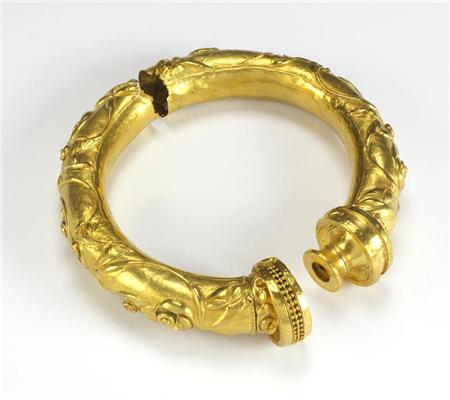
The Broighter Torc is a collar like artifact, measuring about 7.5 inches (19cm) in diameter. It is made entirely of gold. It is believed to have been made in the 1st century BC.
The Broighter torc was found in February 1896 by Thomas Nicholl and James Morrow. These two were ploughing a field close to the shores of Lough Foyle in the north of Ireland, which is now Northern Ireland.
The two came across something hard that was buried in the ground. These items looked like they were made of metal. They also noticed that the items were ‘arranged inside one another’ (O’Neill 1993, p.24). They took the items home and washed them on a sink. Even at that moment, they were still unaware that the artifacts were made of gold. It is said that the maid who washed them later admitted that there might have been some smaller pieces that might have been washed away. (lost history!). The two told the landlord about their finding, who sold it to an antiquarian, who quickly also sold it to the British Museum for around 600 pounds (Claddagh Design)
This hoard of gold artifacts contained a gold torc (broighter torc), a 7 inch long gold boat, a gold bowl and other jewellery.
Design:
The Broighter torc has been considered to be a masterpiece of artwork in the La Tene style (Waddell 1998, 294). The Broighter Torc consists of a hollow circular tube made from a hammered sheet of gold. It has separate buffer terminals that use a mortice and tenon like joint. The fastening at this joint consists of a T piece, which fits into the buffer slot of the torc when the torc is closed. This prevents it from opening (Wikipedia).
The torc has a “sea-horse image” on its tubular gold sheet. It also has leaf and plant designs along the folded tubular gold sheet. The backgrounds is also covered with beautiful geometric curves.
This design in uncharacteristic of the designs found in many other artifacts found in Ireland but quite similar to artifacts found in Britain. It is therefore believed that they were made by a local who had contacts in Britain.
Purpose:
At first, the British Museum concluded that the torc, together with it’s siblings was treasure that was buried with the intention of being discovered later, thereby claiming ownership of the hoard. A man named Arthur Evans filed to dispute the British Museum’s claim in which he argued that the hoard was strategically buried as some sort of sacrifice or gift to win over the Gods. This was highly supported by the presence of sea-horse image on the torc, the boat and also the burial site being very close to the sea.
Torcs were considered to be jewellery by the Celts. They were mostly seen to be worn around the neck, most often in battles or rituals. Torcs were symbols of strength, status and wealth. The better the design, the more powerful the owner was.
Conclusion:
The broighter torc design is very unique, so unique such that it feels like it was made specifically for that purpose. Most other torcs, including neck and arm torcs which were made around the same era share the same design characteristics (curves, symbols of heads). I wish we had more information about the origin of the torc. Was it designed for the purpose of being buried as a gift to the Gods? Was there a powerful man once that deserved such a torc that might have symbolized a very high status? There are still uncertainties on this aspect.
References:
O’Neill, K. 1993. ‘The Broighter Hoard, or how Carson caught the boat’. Archaeology Ireland Vol. 7, No. 2, pp. 24-26
Design, Claddagh. “Irish Treasures: The Broighter Hoard.” Claddagh Design, Claddagh Design, 19 Jan. 2017, www.claddaghdesign.com/history/irish-treasures-broighter-hoard/.
Waddell, J. 1998. The Prehistoric Archaeology of Ireland, Wordwell, Dublin.
Harding, Dennis William. The Archaeology of Celtic Art. Oxford University Press, 2007.
Megaw, Ruth, and Vincent Megaw. Celtic art: from its beginnings to the Book of Kells. Thames & Hudson, 2001.
Cunliffe, Barry W. The Ancient Celts. Oxford University Press, 1997.
Publisher:
National Museum of Ireland
Date:
1st Century BC
Format:
Gold, 7.5 inches in diameter (19cm)