Waldalgesheim torc
Files
Dublin Core
Title:
Waldalgesheim torc
Description:
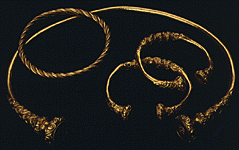
The Waldalgesheim torc is a Celtic artifact from the 4th century BC. A torc is a necklace with an open bottom; they are one of the most common and distinctive relics from the Bronze Age Halstatt and La Tene cultures. (Cunliffe 89,121-124) Torcs were worn across the lands inhabited by ancient Celts, and archaeologists have found them in England, France, Germany, and the Danube River Valley, as well as in other locations of Celtic settlement. (James 11, 24) Additionally, the torc is one of the most prevalent symbols of Celtic culture in contemporary art. The Dying Gaul, a large sculpture in Pergamon, is the most famous example, but figurines depicting Celtic warriors with torcs can be found across the classical world. (Ibid., 34) The torc is made of gold; its diameter is 21.1cm, and it weighs 204.3g. (LAITS 2017) Torcs, especially from the La Tene period, are typically made of gold or copper, which makes this a consistent find with the archaeological record. The torc was found in Waldalgesheim, Germany by a farmer digging a hole for beets in 1869. The farmer was unaware of their significance, but a passing traveler noticed them and suggested they should be studied. (Waldalgesheim Chamber of Commerce 2017) Waldalgesheim is located in the Rhineland of Germany, which places it directly in the heartland of the La Tene culture.
The Waldalgesheim find is part of a larger burial. In addition to the torc, a bronze flagon, golden bracelets or armbands, and an imported Etruscan bronze bucket were recovered. (Koch, 92-93) It is likely that the burial belonged to a woman due to the absence of warrior equipment. (Harding, 45) Due to the preponderance of precious metals in the grave, the current hypothesis of archaeologists is that the site is the burial place of a Celtic princess. (James, 108) While it is unusual to see such a well-adorned female grave during the classical period, there are several surviving examples of prominent Celtic female burials, such as the sixth century BC Vix grave and the recently-discovered third century BC Wetwang Slack Yorkshire cart burial. (Ibid., 67-68) The later examples of Boudica and Cartimandua in Britain, as well as the Maeve of Connaught legend in Ireland portray women obtaining power in Celtic society. These stories are reinforced archaeologically by the prevalence of opulent female burials. (Ibid., 67)
The artifact is the archetype of the vegetal style of the La Tene culture. The vegetal style is a plant-derived pattern with strong Classical influences. (Ibid., 108) The most common pattern is the running tendril motif, which can be seen clearly on the ends of the torc and bracelets from the Waldalgesheim find. (Cunliffe, 119) The shift to this plant-based style from earlier Celtic art, which more prevalently featured animal and human head motifs, was likely precipitated by contact with the Classical Graeco-Roman world. The presence of an imported Etruscan bucket at the Waldalgesheim find underscores the likelihood that this area was in frequent trade contact with Italy, and therefore would have been influenced by Etruscan artistic styles. The similarity of Waldalgesheim, and other vegetal finds such as the helmets in Amfreville-sous-les-Monts, to Etruscan art engenders the hypothesis that this style began in the Celtic settlements in the Po Valley and then spread across the continental Celtic world. (Harding, 75, James, 108) Waldalgesheim style art has been found across Central Europe, from the Seine to the Danube, and it comprises a large portion of what is identified as La Tene art. (Kipfer 596)
Bibliography
Cunliffe, Barry. 2000. The Ancient Celts. London: Penguin Books.
Harding, D.W.. 2007. The Archaeology of Celtic Art. Abingdon, United Kingdom: Routledge.
James, Simon. 2005. The World of the Celts. London: Thames & Hudson.
Kipfer, Barbara. 2000. Encyclopedic Dictionary of Archaeology. New York: Springer
Koch, John. 2005. Celtic Culture: A Historical Encyclopedia. Santa Barbara, California: ABC-CLIO.
University of Texas at Austin. 2017. “Waldalgesheim.” Accessed October 24, 2017. http://www.laits.utexas.edu/ironagecelts/waldalgesheim3.php
Waldalgesheim Chamber of Commerce. 2017. “Walgaldesheimer style.” Accessed October 24, 2017. http://www.waldalgesheim.de/fuerstengrab.html
Creator:
Nick Lowell
Publisher:
Rheinischen Landesmuseum
Date:
350-325 BCE