The Braganza Brooch
Files
Dublin Core
Title:
The Braganza Brooch
Description:
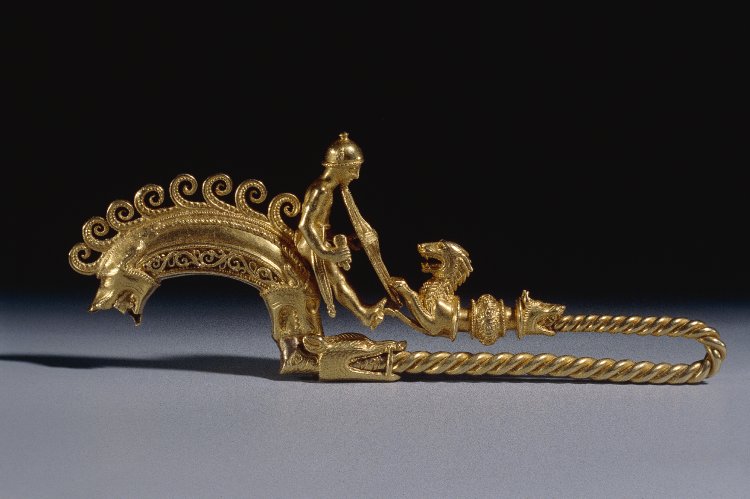
The object is a gold fibula, or pin, most likely donned as an accessory for clothing. It is about 5.5 inches long. It is made out of gold, with the figures’ eyes originally inlaid with glass enamel. It was most likely found Spain. An exact find spot is not known. It has been assumed that the brooch was once part of a burial of treasure hoard. It was most likely made between 250-200BC (British Museum). There was is no documentation, archeological or otherwise, of its excavation. It is thought that the brooch was formerly in the collection of the Royal House of Braganza, perhaps in the collections of Ferdinand of Saxe-Coburg, consort of Queen Maria of Portugal. In 1919, a duchess of the Braganza dynasty emigrated to America, and upon her death in 1941, the collection of jewels was sold to Warren Piper of Chicago. The brooch was then bought in 1950 by Thomas F. Flannery Jr. at the Warren Piper sale. The British Museum first examined it in 1965 and later acquired it in 2001 (British Museum).
On one side, the brooch has an arched bow, with a somewhat abstract dog head on either end. The bow is decorated with 8 curls along the arch and an elaborate curved design on its sides. Then it has a long twisted foot of wire. Where the bow and the foot meet on one side, there is a boar’s head. On the other side, there is another dog head, and the upper body of another dog jumping onto the shield of a warrior. The warrior is naked except for his helmet, shield, and scabbard suspended from his waist. He is holding a sword that appears to be broken off. The hinge and pin of the brooch have been lost. The scabbard and pommel of the sword both resemble La Tène style art (British Museum). The hilt-end is convex, however, which is not a good fit for the style. This sword type is undocumented in France, Italy, or Spain. The trilobate style pommel however is known from earlier Iberian art (Quesada 148). The warrior’s helmet is thought to be modeled after some sort of Montefortino type helmet, which was Italo-Celtic (Quesada 144). The shield closely resembles a winged or band-plate boss, a common shield type in Gaul, Italy, and Iberia between 300 and 125 BC. The warriors shield is a small but structurally accurate model of one of these shields (Quesada 140-141).
There are no literary sources that describe Celtiberians marching naked into battle, but many bronze naked warrior figures have been found in Andalusia and Murcia, so naked warriors were an iconographic and possibly symbolic figure (Quesada 152). The study of the warrior and his weapons has led some historians to guess that the brooch’s place of origin was the lower Ebro valley, where the most La Tène type weapons have been found in Iberia, and the scabbard suspension depicted on the warrior is common. This region also has produced other archeological finds that fit with the Greek or Hellenistic undertones of the brooch (Quesada 153). The detail and realism of the human and animals is not usually common in the La Tène style. It has been hypothesized that the brooch was made to depict a Celtiberian warrior by a Greek craftsman, possibly for an Iberian prince (British Museum).
The lack of scientific documentation of the brooch’s excavation, along with its stylistic anomalies and lack of close comparisons from other excavated pieces means there is little solid historical context for the brooch. This has brought some art historians to question whether the evidence that current historical interpretations are based on is sufficient. They do not think there is strong enough evidence to state confidently that the brooch was once in the Braganza collections. Additionally, they find the assumption that the brooch was made by a Greek to be complete conjecture, lacking an any true archeological evidence (Simpson 29-32).
In my personal analysis of the brooch, I find it incredibly intricate and showy, so much so that it could not be appreciated fully just being worn. It is also rather large for a pin. It would make more sense to me if it was in the burial or hoard of a wealthy warrior or noble. It also struck me how detailed and clear the depictions of the animals and warrior are. It seemed less abstract than other examples of La Tène art that I had seen.
In my opinion, the animal heads were particularly striking and impressive. They have intricate details, especially in their mouths. I could definitely make out the two animal heads on the twisted wires to be a dog or wolf and some sort of boar or pig. I was less sure of the type of the other animals. I definitely understand how they look like dogs, but they also look somewhat like lions or lion-like beasts to me. The 8 decorative curls on the arch of the bow could even be interpreted as a sort of mane on the neck of one of the creatures.
I wish I knew the details of the brooch’s original excavation to mare clearly understand its historical context. Additionally, I wonder if there is significance behind its design. I would love to know if the brooch was depicting a Celtiberian story or event that had to do with a warrior fighting off an attacking dog or beast.
Works Cited
British Museum Collection Database. “2001,0501.1” www.britishmuseum.org/collection, British Museum. Online. Accessed 10/20/2017.
Quesada, Fernando, and Alicia Caveda Perea. The Braganza Brooch Warrior and His Weapons: The Peninsular Context. La Fíbula Braganza = The Braganza Brooch, Ediciones Polifemo, 2011, pp. 137–156.
Simpson, Elizabeth. “Tall Tales: Celts, Connoisseurs, and the Fabrication of Archeological Context.” Source: Notes in the History of Art, vol. 24, no. 2, 2005, pp. 28–41. JSTOR, JSTOR, www.jstor.org/stable/23208111.
Publisher:
Currently on display at the British Museum
Date:
Most likely made between 250-200BC
Format:
Dimensions - Height: 5 centimeters, Width: 14 centimeters, Depth: 2.5 centimeters
Material - gold and glass