The Battersea Shield
Files
Dublin Core
Title:
The Battersea Shield
Description:
The Battersea Shield
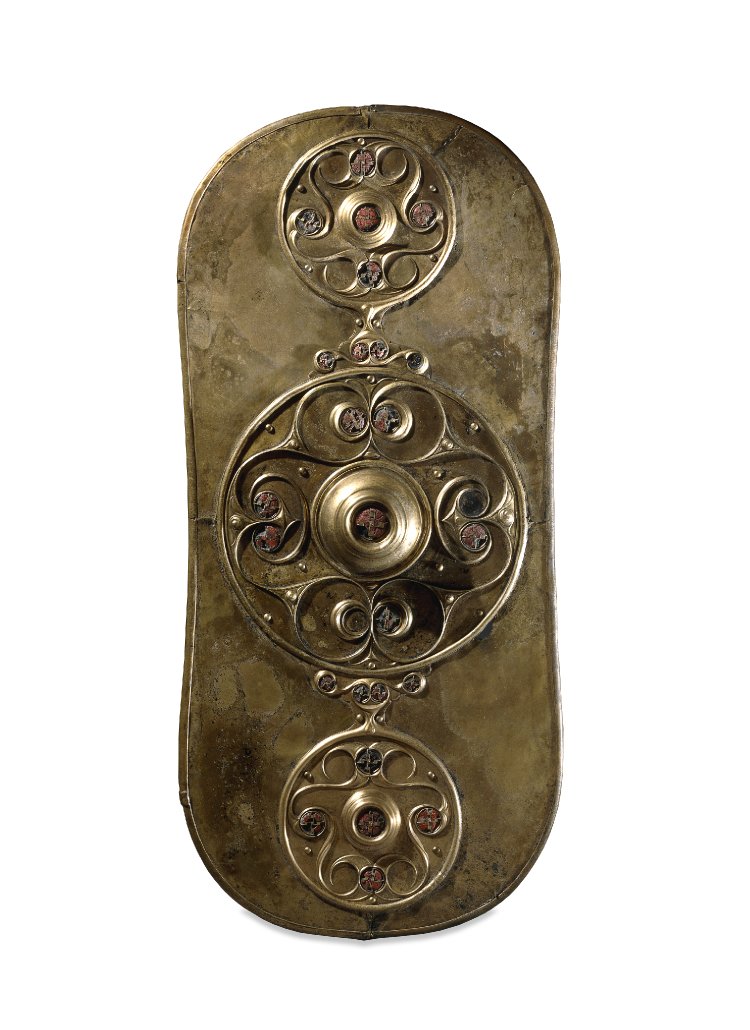
The Battersea Shield is a small shield covering (though it will henceforth be referred to as a “shield”). Although it appears to resemble a shield that Celtic warriors might have used in battle, it is more precisely a covering that would have sheathed a wooden shield. Scholars have concluded that it is too small and fragile to have ever been used in battle––It is about 2.5 feet long and 1 foot wide. Scholars instead believe that the shield was either created for prestigious display, or created as a votive offering––an object deposited somewhere like a river or a lake as an offering to a god. The shield’s main material is bronze, but it also features what is commonly referred to as “red-glass” or “enamel” inlays. The inlays are technically neither glass nor enamel, but rather glass heated to a spongy consistency that was pressed into the bronze backing. The shield is comprised of three distinct bronze pieces that are mounted on a back sheet (Harding 2007, p. 152).
The shield was found in the Thames River, which supports the contention that it was created to serve as a votive offering. There were many other Roman and Celtic weapons, as well as human skeletons, found at the same site as the shield. Some scholars initially took this to indicate that the site where the shield was found was the location where Julius Caesar crossed the Thames during his invasion of Britain; however, now the shield is thought to have been deposited in the river before this event as a votive offering. The shield was discovered in the Thames during excavation for the Chelsea Suspension Bridge in London in 1857 (McNeill-Ritchie 2007). It is estimated that the shield was created during the Iron Age between 350 and 50 BC; it is difficult to pinpoint an exact date of creation because the shield does not stylistically resemble any other Celtic object found in Britain (The British Museum).
The most immediately visible, and commonly noted, design elements are the three roundels, or small disks, that occupy the face of the shield. The high-domed boss, or knob, in the center of the shield is also cited as a significant design element. The boss is typical of the La Tène style, and was produced using the repoussé technique, meaning it would have been hammered in from the other side. The red-glass enamel circles and the spirals that surround them were also cited as significant features (The British Museum). S-scrolls flow around the circles in a way that suggests that the circles might be features of a human or animal face (Harding 2007, p. 152).
The most salient aspect of the shield for me is the detail of the flowing S-curves. Their symmetry indicates a high level of craftsmanship and attention to detail. I find the shield to be very elegant––For this reason, it makes sense to me that it wouldn’t be used in battle. I could see the shield being showcased in the home of a powerful British Celtic family, or being disposed of in the Thames with great reverence. Conversely, I find it highly unlikely that such a richly detailed and decorated object would have been used as a protective surface that would have eventually been battered and beat down over the course of battle.
I wish I knew how many of these objects were made; scholars have only ever found one, but I wonder how unique this item was. If this were a rare item, would owning it or offering it to a god be a marker of high status? I would also be curious about whether the S-curves that enclose the central boss are meant to represent a human or animal face, or neither. I find it difficult to see a face in the design, but if the curves were meant to represent a face, would that face be an abstract symbol, or a reference to a particular person or god? Finally, if the shield were a votive offering, for which god was it intended? Are there particular design elements––perhaps the red-glass enamel circles––that were created to specifically appease a certain god?
Works Cited
Harding, D. W. (2007). The archaeology of Celtic art. Abingdon: Oxford University Press.
McNeill-Ritchie, S. (2014). Battersea through time. Stroud: Amberley.
The British Museum. (n.d.). The Battersea Shield. Retrieved October 25, 2017, from http://www.britishmuseum.org/research/collection_online/collection_object_details.aspx?objectId=831341&partId=1
Publisher:
The British Museum
Date:
350-50 BC