The Gundestrup Cauldron
Files
Dublin Core
Title:
The Gundestrup Cauldron
Description:
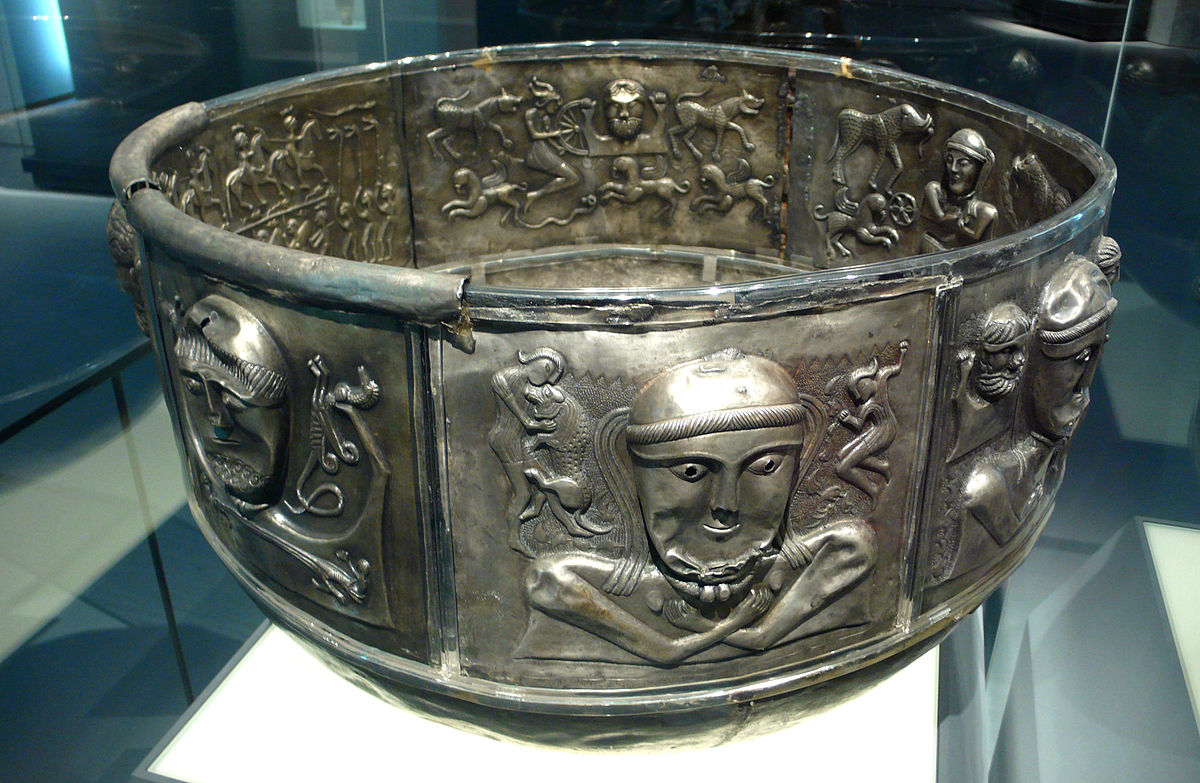
1. The Gundestrup Cauldron is a circular vessel twenty-seven inches in diameter and seventeen inches in height. However, it is important to note that this a modern reconstruction: The Cauldron was discovered in fifteen separate pieces, including five inner and seven (out of a possible eight) outer plates, a base, and two lengths of tubular reinforcement. The Cauldron shows evidence of recycling (the plates may have been part of another container) and up to five separate rounds of repairs (the base contains a bridal ornament, which scholars believe served to plug a leak in the base). Judging by its fine craftsmanship and quality, the Cauldron was probably decorative, and may have been a diplomatic gift.
2. The Cauldron is beaten out of sheet silver, which is unusual for north-western Europe, where gold and bronze where far more common for large vessels. The idiosyncratic material of the Cauldron has led some scholars to believe that it has its origins south-eastern Europe, perhaps in Thrace, where silverwork on a large scale was far more common. Although a Thracian origin would mean that the Cauldron made a transcontinental journey, this is entirely possible, as there was a Celtic raid of Delphi in 279 B.C. and a continued Celtic presence in what is today Bulgaria from around the same period. Indeed, certain decorative details on the Cauldron make this likely: The antlered man’s crisscrossed shoelaces along with the appearance of elephants and a wheel-bearing god are markedly eastern and Thracian.
3, 4, 5. Peat-cutters working in a bog near the Danish town of Gundestrup discovered the deconstructed Cauldron on May 28, 1891. Shortly after the discovery the Danish government took possession of the Cauldron and placed it in the National Museum in Copenhagen. The context of the Cauldron is, in some ways, difficult to discover. Its discovery in a bog led some scholars in the 1890’s to believe that it may have been a bog offering, but early paleobotanical analysis of the ground where the Cauldron was found showed that the Cauldron was probably deposited there before the bog developed. Taking into consideration that the Cauldron was carefully deconstructed and then laid on dry ground, scholars now believe that someone may have been attempting to hide the Cauldron, perhaps intending to reclaim it at a later time.
6. The Cauldron was not found with any other objects, such as coins or shards of pottery, that would allow the deposit to be dated. In addition, the five separate sets of repairs to the Cauldron prove that it must have been in circulation long before it was abandoned. Thus, there is a wide range of scholarly estimates for the date of the manufacture of the Cauldron, from about 300 B.C. to 50 B.C., but there is some consensus that it was left near Gundestrup around the time of Christ or very shortly after.
7. The most significant design features of the Cauldron are the designs beaten into its inner and outer plates because they have inspired much debate about the origins of the Cauldron. As referenced above, some aspects of the designs are not Celtic, such as the shoelaces, the elephants, the wheel-bearing god, the ivy leaves in the background, Hercules and the Neman Lion, the boy on the dolphin, and the arguably Roman gods on the outer plates. Further, all of these designs are attested in Thracian art of the same period. However, there are some elements of the design that complicate this Thracian origin thesis. First, several of the figures on the Cauldron (including the antlered man) sport distinctively Celtic twisted torcs and other gear well-attested in contemporary Celtic art, such as long shields with circular devices, bird-crested helmets, a certain type of pants, and war trumpets. Second, one could read some of the gods as stylized representations of the Celtic pantheon. The antlered man could represent Cernunnos (although the only known representation of Cernunnos, a statue from Notre Dame, has horns instead of antlers) and the wheel-bearing god could represent the Celtic wheel god Taranis. Third, some scholars wonder if trans-continental trade and certain acts of war, such as Hannibal’s transalpine march, could account for the appearance of elephants on the Cauldron.
8. I personally see this object as an impressive work of silver-work with an especially interesting provenance. If the Cauldron does come from Thrace, then its designers must have deliberately made some aspects of their designs Celtic by adding the torcs and other Celtic aspects, which suggests to me that they must have intended it for a Celtic audience. Then the object made its way not into the Celtic world, but far into the Germanic north. Finally, the Cauldron was deconstructed and hidden for reasons no one can now tell. I wish I knew who made it and from whom, how it got to Gundestrup, and why it is hidden and forgotten.
Publisher:
The National Museum of Denmark, Copenhagen
Date:
approx. 300- 50 B.C.
Format:
17 in x 27 in, silver